Why a 24/7 telehealth line went unused
The insurance company funded 40 nurses, 24/7, only to receive 41 calls a day. With over a million members, that meant only a 1.5% utilization rate, but 100% the cost.
Context
My Role and Team
I was brought in as the Lead Service Designer and Researcher for Phase 2 of 3-Step Innovation Campaign by G2O. I lead one of the multiple workstreams for the client, a Health Insurance company.
My role was to:
Blueprint one of the client’s services
Simultaneously teach the client how to blue print one of their own services
I was the lead--I owned the direction and methods, led the workshops and co-design sessions, established the timeline and cadence and more. Our immediate team included Emma Pipes and Lauren Hoffman.
Problem
Originally, the problem was very simple. We were meant to help the client answer the question:
“Which of our services would have the highest impact if we blueprinted it ?”
However, redirection happened. Midway through leadership set that question aside and pointed us at a single service instead. What looked like a narrower assignment turned out to grow two more heads:
How do we make a third-party vendor's system legible, while still finding opportunities the client can act on directly?
How do we help an organization build the capacity to see whether its own services are actually working?

I’ll explain these additional two problems and how we solved them in the deep dive section of this case study.
Summary
General Findings
I was brought in to blueprint a high-impact service for a health insurer with over a million members. Leadership redirected the work there mid-engagement, after our initial research pointed elsewhere.
Mapping the service, Nurseline, revealed the following:
That only 1.5% of members utilized the service and the reasons why
The company’s main success measure was simple: decrease unnecessary ER visits by getting members to use the Nurseline instead. To hit that measure, they believed the line was fielding 30 to 40 ER-related calls a day, a subset of a much larger total call volume.
It wasn't a subset. It was the total. Thirty to 40 calls a day, full stop, against a membership of over a million. That works out to roughly 15,000 calls a year, staffed around the clock by 40 nurses.
Their measure of success was off.
What does that mean for the business?


The Main Outcome
The blueprint was the first comprehensive map of how the service actually worked.
Stakeholders saw aspects of their own service for the first time: the utilization math, the access path, the awareness lottery. These were not facts the organization had been ignoring. They were facts it had never been able to assemble.

We then co-designed seven concepts that were prioritized for consideration to help bridge the gaps the Blueprint surfaced.

We made the invisible visible, and that let the organization see its bottlenecks, its friction, and the reasons behind both for the first time.
The Process
The rest of this case study will go into the project in detail.

After our kick-off, I sat down to draft out a plan that covered the entirety of the 4 1/2 month project.
We kept our team aligned by having weekly touchpoints with the stakeholder every week. Each Monday, we would present out our findings--that way, no one felt blindsided by the information we were surfacing.
Phase 1:
Stakeholder Interviews
Concurrent with additional research (secondary research). We got our hands on whatever documentations and reports we could find about how different departments within the client's org worked.
Additional Interviews
I think one thing that's always important as a research is to admit when I don't know something. The way my process works is that I collect information, begin to form the edges of a puzzle, and from there I continue working inwards.Initial mapping.
Our first understanding of the current-state of the client's massive org
Current Ecosystem Map
Our final round of research. We had sat down with multiple people across all departments, including third party vendors, and had gotten a very clear of idea of what was going on and why.
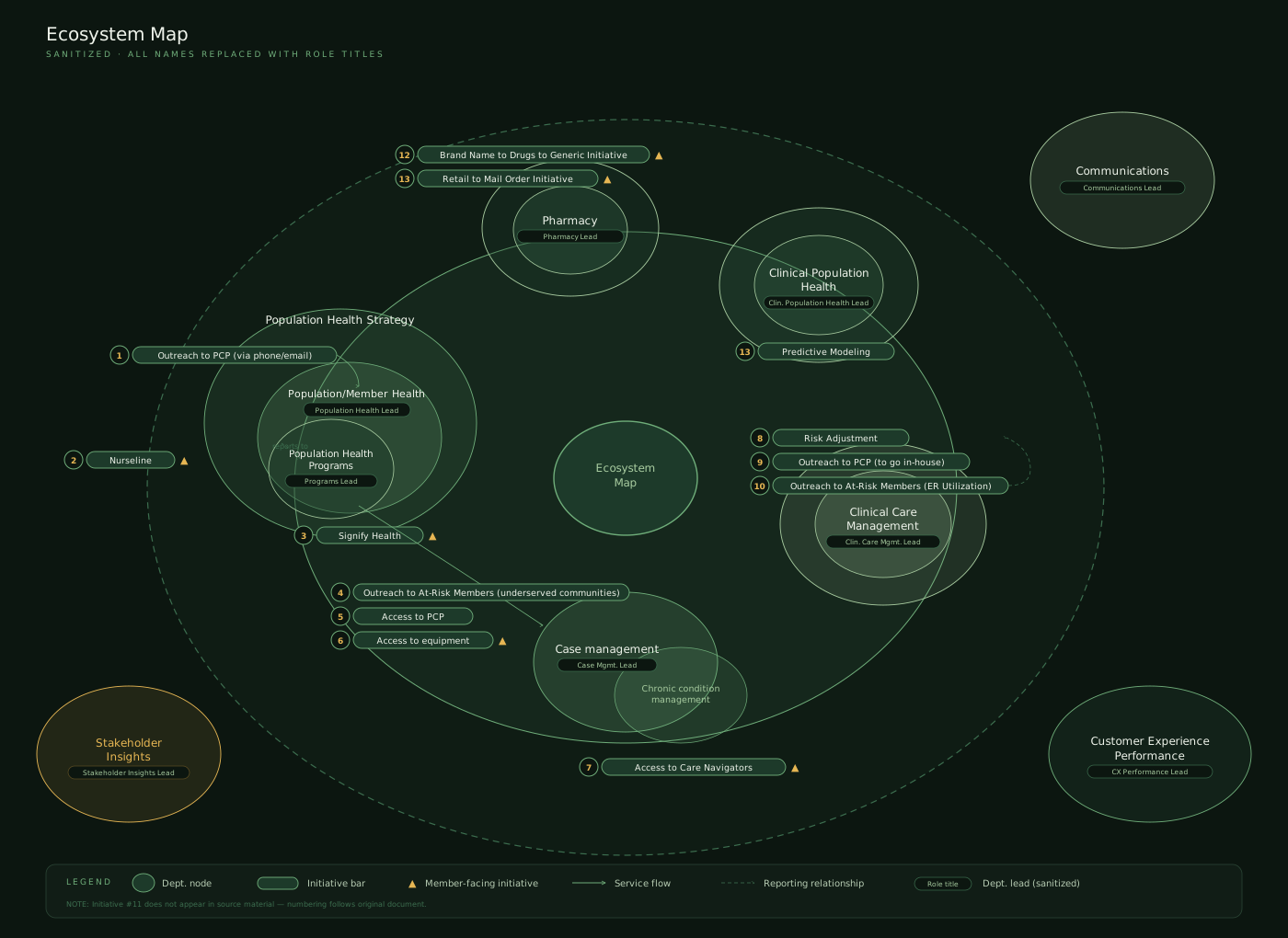
Complications
There was a rigorous process in place to help us choose the highest impact focus areas. Across our interviews, we found 9 Focus Areas across 3 different departments. We then presented these findings and we ran into our first major obstacle.

Unfortunately, leadership stopped the process and decided to go with a service that hadn't come up at all during interviews.
The engagement was redirected to a service called Nurse Line, a 24/7 clinical triage service that most members didn't know existed.
I spent the next two sessions trying to reconnect the decision to the original research.
So I made a different choice. Rather than treat the pivot as a derailment, I treated it as the new research question:
Why this service, and what would rigorous service design reveal about a part of the organization no one had asked us to look at — and that, it turned out, the organization itself had never examined closely?"
Research and Discovery
Again, Nurse Line hadn't appeared in any of our initial interviews. No one on the team could tell me how it actually worked. So I treated that absence as the finding it was, and went to map the service from scratch.
My team and I ran a second round of interviews. And since Nurse Line itself was housed by a third-party, it meant going past the insurer's walls and into the territory of the vendors.
Immediately, we ran into some surprises.
1. The Service wasn't the insurer's to see.
The Nurse Line is not the insurer's product.
It is operated by a third-party vendor that we'll call Flume Health (Note: this is not the real name of the vendor).
From our interviews, we learned that the insurer pays a flat per-member fee for 1+ million users, and in return they receive a montly report. Beyond that monthly report, the insurer knew very little about the service. They had no visibility into:
The scripts the nurses used
The protocols used to route a call
What happened after the member hung up
The actual service was happening inside of a black box, and, unfortunately, the insurer was on the outside of that box.
We interviewed the vendor directly.
2. The insurer had misread their partnership with the vendor.
Going in, the team believed the Nurse Line redirected 30 to 40 calls a day, and that this was a curated slice of a much larger volume.
It was not a slice.
It was the total.
Roughly 15,000 calls a year, against a membership of more than one million.

3. And no one had really looked into things to do the math.
Around 40 nurses staffed the line 24 hours a day, seven days a week, to answer about 40 calls a day.
Utilization sat near 1.5 percent of the membership.
The headline metric that Flume Health reported to the insurer was that they had accomplished a 92 percent ER avoidance rate.
Again, this sounds great, but what the insurer missed was that the vendor was only counting calls against those ALREADY facing a possible ER visit. The crucial information that the insurer was missing was how many members, in total, called the Nurse Line.

Three Crucial Findings
1. Blueprinting
These findings did not come from a conversation. They came from the blueprint.
We started mapping out our qualitative data to the framework of an experience lifecycle.

From there, my team and I built a full current-state service blueprint of the Nurse Line. We mapped the following:
The member-facing steps across the top
The onstage roles members touched
The backstage infrastructure the members never saw
The supporting systems
The touchpoints and artifacts
The policy constraints
The metrics, where any existed
Laying the whole service out in one view is what made the failures legible. Three of them mattered structurally. Read separately they look like three different problems. Read together they are one organization that never built the infrastructure to run the service it was paying for.

2. The Insurer did not understand their own service.
This surfaced in the backstage layer, the part of the blueprint the insurer had never seen.
The team had misread the call volume
They had no view into the clinical protocols
They had never audited the scripts their members were hearing on the line
This is what happens when the knowledge of a service migrates entirely to a vendor and the internal capacity to evaluate it quietly withers. The insurer was accountable for a clinical service it could no longer see inside of.
3. Member awareness came down to chance and even if a member wanted to reach the service, it was extremely difficult for them to do so
This surfaced when we traced the awareness step back through its touchpoints.
Whether a member learned the Nurse Line existed depended on three independent variables:
The member's plan type
Choices made in a single onboarding email.
Whether leadership prioritized Nurse Line communication that year.
Three coin flips stood between enrollment and ever knowing the service existed. Commercial group members were excluded from the communication entirely, by policy.

Design Response
What we built, and what it could and couldn't fix
The blueprint and the findings were the diagnosis.
We were bought on to produce design concepts, and so we ran co-creation sessions with stakeholders and then with the entire design team of G2O. Together, we generated seven concepts organized around the two failures a member actually encountered:
Not knowing the service exists
Not being able to reach it
Awareness: 3 concepts
An educational onboarding flow that introduces the Nurse Line as part of joining the plan, rather than burying it in a welcome packet.
A personalized resources view that surfaces the surfaces resources available to the members when they're most likely to need it.
A reminder-of-benefit link that resurfaces the Nurse Line at moments when a member is already thinking about care.

Access: 4 concepts
A quick link to the service on the public site, so it isn't five clicks behind a login.
An add-to-contacts option so the number lives in a member's phone before they need it.
A message-or-call-a-nurse entry point that meets members in the channel they prefer.
A nurse line report summary that gives the insurer a clearer view of what the service is actually doing.

But what about the root issue?
I want to be straight about what these concepts were meant to be. They are responses to the two gaps members hit, AND a few of them would measurably help. But set against the diagnosis, most of them are improvements to a single service inside an organization that has the same problem thirteen times over.
Making the Nurseline easier to find does not give the insurer a way to make their next twelve services findable. It is rearranging furniture in a single room of a house with no floor plan.
That gap was not an oversight. The engagement was scoped to the Nurse Line.
While the concepts were the right deliverable for the engagement, the most impactful finding was the diagnosis.
Outcomes
What changed?
The blueprint was the first comprehensive map of how the Nurse Line actually worked. Before it, no one within the insurer could draw the service end-to-end. After that, they could see the vendor relationship, the call-volume reality, the access path, and the communication logic in a single view.
Stakeholders saw aspects of their own service for the first time.
The utilization math, the five-clicks-and-a-login access path, the three-variable awareness lottery: these were not new facts the organization had been ignoring. They were facts the organization had never been able to assemble. Watching people recognize their own service in the blueprint was the clearest evidence the work mattered.
The seven concepts were prioritized for consideration. The co-creation sessions gave stakeholders a shared set of options and a way to weigh them, which is its own outcome regardless of what shipped.
The program was structured in three phases, and phase three, the orchestration and governance work that would have addressed the operating-model problem, was never reached. I was laid off the following month. I left with the diagnosis delivered and the harder question, the one about the operating model, documented but unowned.
What I can claim is the diagnosis. A service no one could describe became a service the organization could finally see, and the pattern behind it became visible for the first time. Whether they acted on it is theirs to answer. I was there to make the invisible visible.

